Objekt 2204
Hazardous accident and turning point – The Schweizerhalle chemical spill
Description
1,351 tons of chemicals went up in flames in the Schweizerhalle fire of 1 November 1986.
While fighting the fire, 500 tons of chemicals, some highly toxic, entered the Rhine via the dousing water. The entire stock of eels along the stretch downriver 400 km long died.
In 1987 those states with banks on the River Rhine passed various measures for the reduction of risk, the improvement of water quality, and the removal of obstructions for the fish.
In 1987 Sandoz paid the City of Basel 860,000 francs compensation for the consequences of the catastrophic fire in Schweizerhalle.
The first treatment plant waste water from the chemical-pharmaceutical industry began operations in 1982.
In 1831 the first bathhouse below the Pfalz was opened for men; in 1847 the women’s bathing section followed somewhat further upriver.
Nearly 4,000 people took part in the 38th official Rhine Swim in 2018.
On October 5 2008 a salmon was caught in Basel for the first time in 50 years.
In 2015 41 species of fish and crab were documented in the Rhine in Basel.
In 2015 153 tons of organic micropollutants were found in the Rhine in Basel, including 18 tons of pharmaceutical substances like antibiotics, hormones and painkillers.
On February 27 1991 the Federal Major Accident Ordinance came into force.
As a reaction to the Schweizerhalle catastrophe, various civic initiatives arose such as ‘Action Self-Protection’ or the ‘Working Group Eco-City Basel’.
Object description
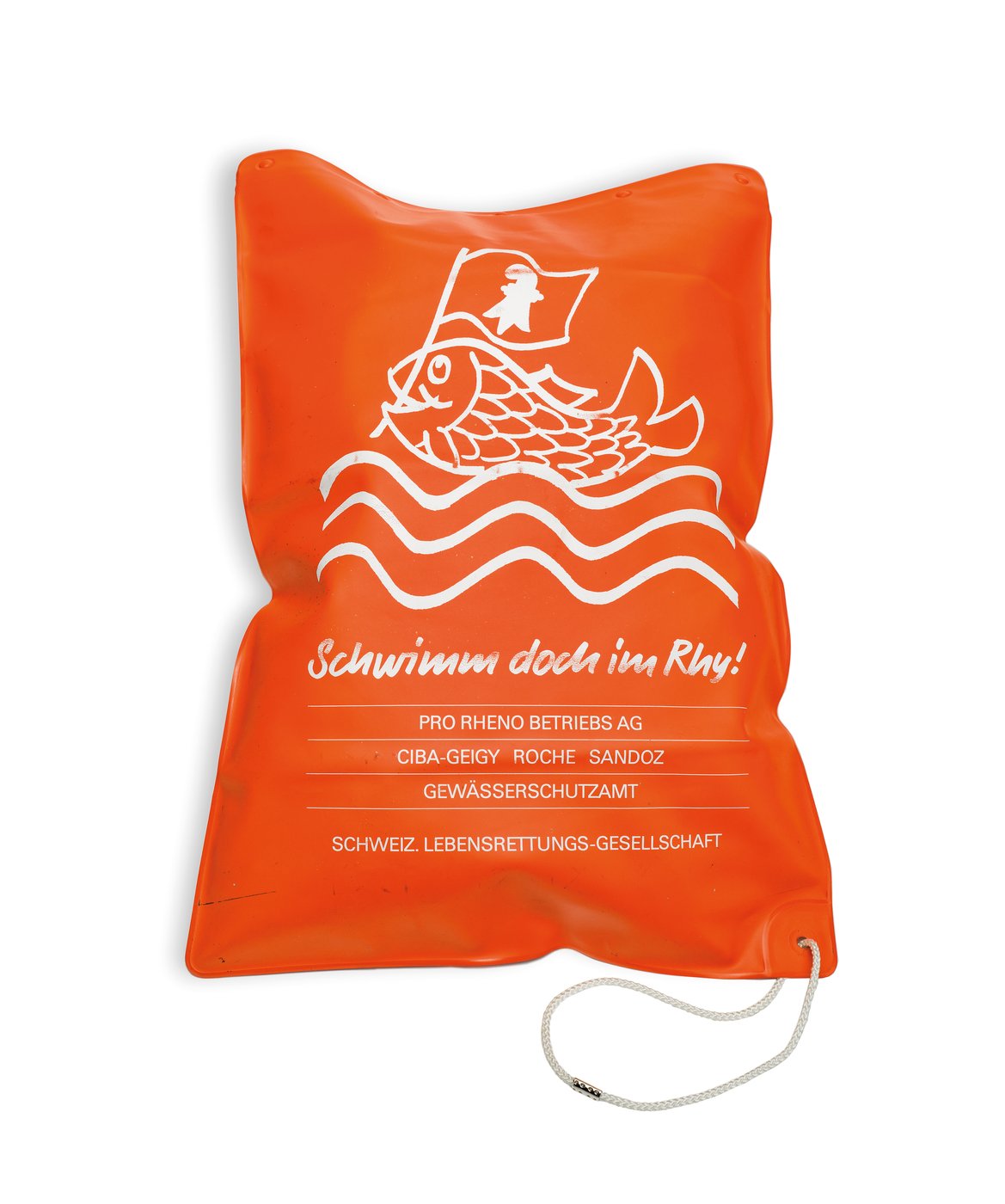
<h4>Go for a swim in the Rhine!</h4>
<p>This Basel swimming bag was created in 1985 as an advertising product. Its
slogan ‘Go for a swim in the Rhine!’ intended to bring across the message
that the Rhine was now clean enough to swim in, as a treatment plant for
waste from the chemicals industry had been successfully up and running
for some time. Behind the campaign were the treatment plant operators,
ProRheno, the chemical-pharmaceutical companies, the cantonal Water
Protection Office and the Swiss Life Saving Society. After the disastrous
chemical spill at Schweizerhalle, bathing had been prohibited between
November 1986 and April 1987.</p>
<p class="adddivider">
<span>Swimming bag</span>
<span>Sarnen, 1985</span>
<span>PVC, synthetic fibres, metal</span>
<span>donated by Anita Friedlin Stahel, Basel</span>
<span>Inv. 2017.299.</span>
</p>