Objekt 16
Fortepiano by Nannette Streicher-Stein, 1816
Description
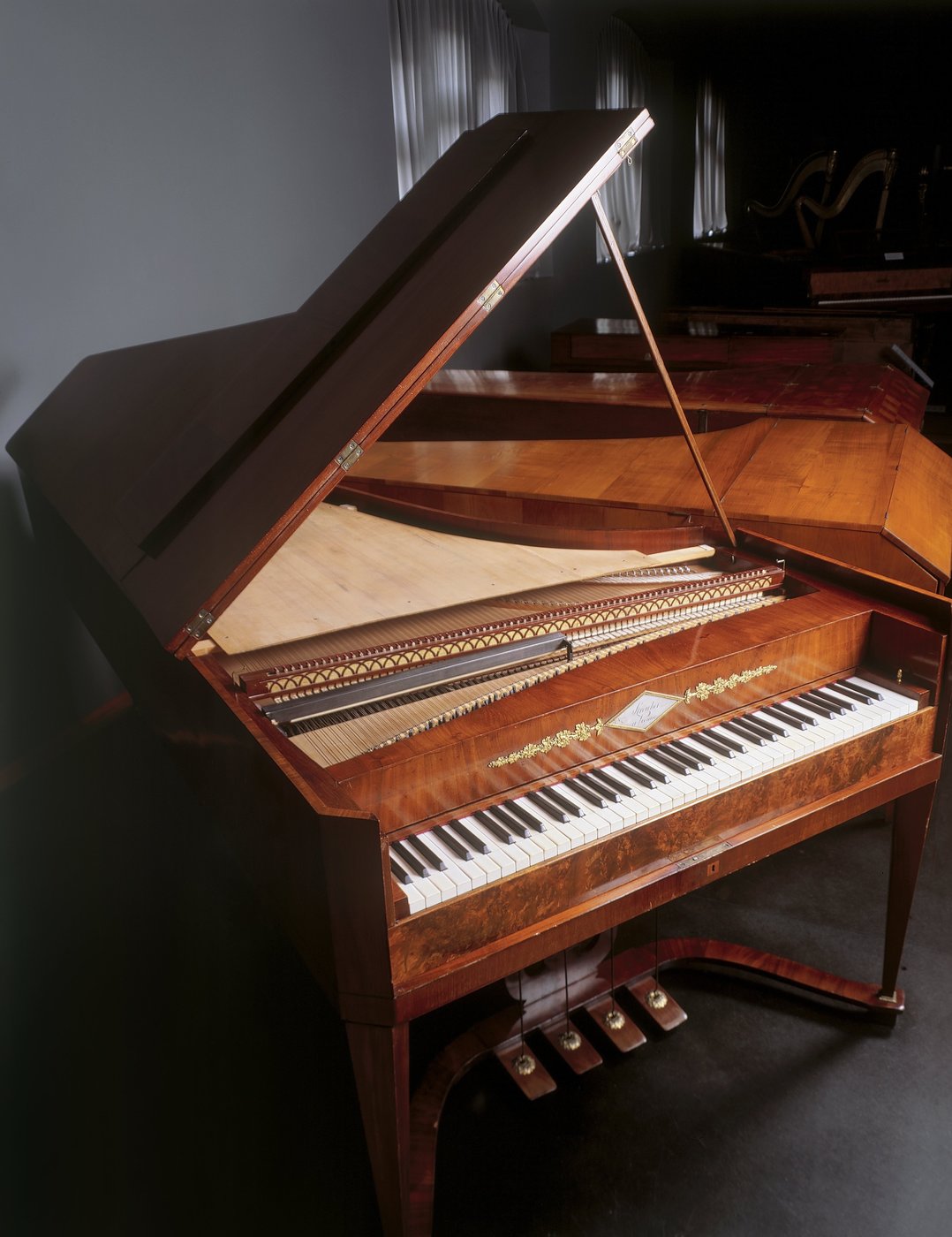
The fortepiano by Nannette Streicher-Stein represents a Viennese instrument of the second decade of the 19th century. The keyboard range is extended from five to six octaves. The knee levers have given way to four pedals. These allow sound effects typical of Viennese fortepianos.
The first pedal from the left causes the keyboard to shift so that the hammers strike only one string per key, hence the name 'una corda'. This produces a softer sound.
If you press the second pedal from the left, a thin roll of paper is placed on the strings from F1 to f1. When the strings are vibrated, they touch the paper roll and a somewhat buzzing sound is produced. This has been compared to that of the bassoon, hence the name 'bassoon draw'.
When the third pedal, the 'moderator', is operated, strips of cloth are passed between the hammers and the strings. The result is a quieter and significantly softer sound.
The fourth pedal is used to cancel all dampers and corresponds to the right pedal of the modern grand piano.
Another Viennese specialty is the soundboard above the strings. It is as thin as a soundboard and is designed to blend the sound.
Object description
Nannette Streicher-Stein (1769-1833)
Vienna, 1816, dated
Nannette Streicher née Stein / à Vienne (alabaster shield with brass frame, front board); Nm 1147. / Nannette Streicher née Stein / Vienne 1816. (handwritten, ink, soundboard, center front)
Mahogany veneer on spruce (case)
Range F1 - f4; bouncing tongue action; upper damping
four pedals (from left to right): 1. una corda, 2. bassoon slide (F1 - f1), 3. moderator, 4. damper lift
H. 893 mm (total); H. 309 mm; B. 1192 mm; L. 2315 mm (case); Stroke measure 473 mm; Octave measure 156 mm
Deposit Paul Sacher Foundation, Basel Inv. no. 1986.105.