Objekt 15
Pianino with Janko and normal keyboard (pivoting), 1908-1910
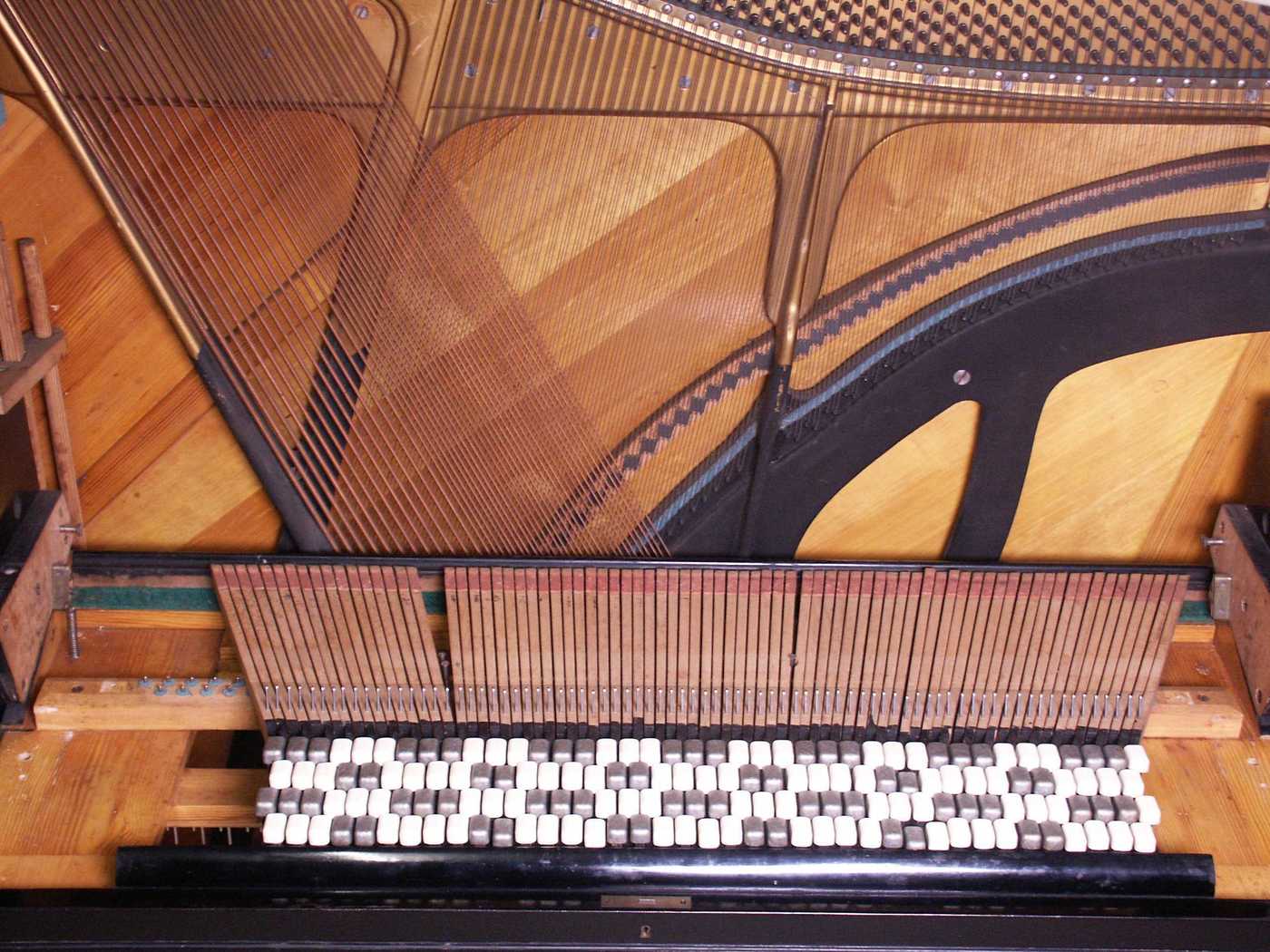
Description
The only special feature of this piano is the staircase-like ascending keyboard. Its basic principle consists of two whole tone scales offset against each other (the distance to the next key in the horizontal plane is always a whole tone step, to the row above it a half tone step). The keyboard begins at the bottom left with the notes a-h (light keys), followed by c-sharp-es (dark keys) as well as f-g-a-h (light keys); above that, b (dark key) and c-d-e, and so on. The following third row repeats the first, and finally the top row repeats the second, making each tone available at two different levels.
The mathematician Paul von Jankó (1856-1919) designed this reform keyboard in 1882 in order to adapt the "normal" keyboard (with a C major scale on the lower keys and five "accidental" notes on the upper keys), which dated back to the 15th century, to the musical requirements of modern times. At the same time, ergonomic needs of the human hand were to be taken into account: While usually in piano lessons the hand had to be laboriously accustomed to the keyboard, he had "adapted the claviature to the hand." It also makes transposing easier, since any key can be played with the same fingering. In addition, it allows for a more natural hand position and a wealth of new fingering possibilities. Despite these advantages, this keyboard famously failed to catch on.
Object description
Carl Goetze Company
Berlin, between 1908-10
Range A2-c5 (88 keys)
Gift of Dr. Hansjakob von Matt, Zurich
Inv. no. 1980.75.